

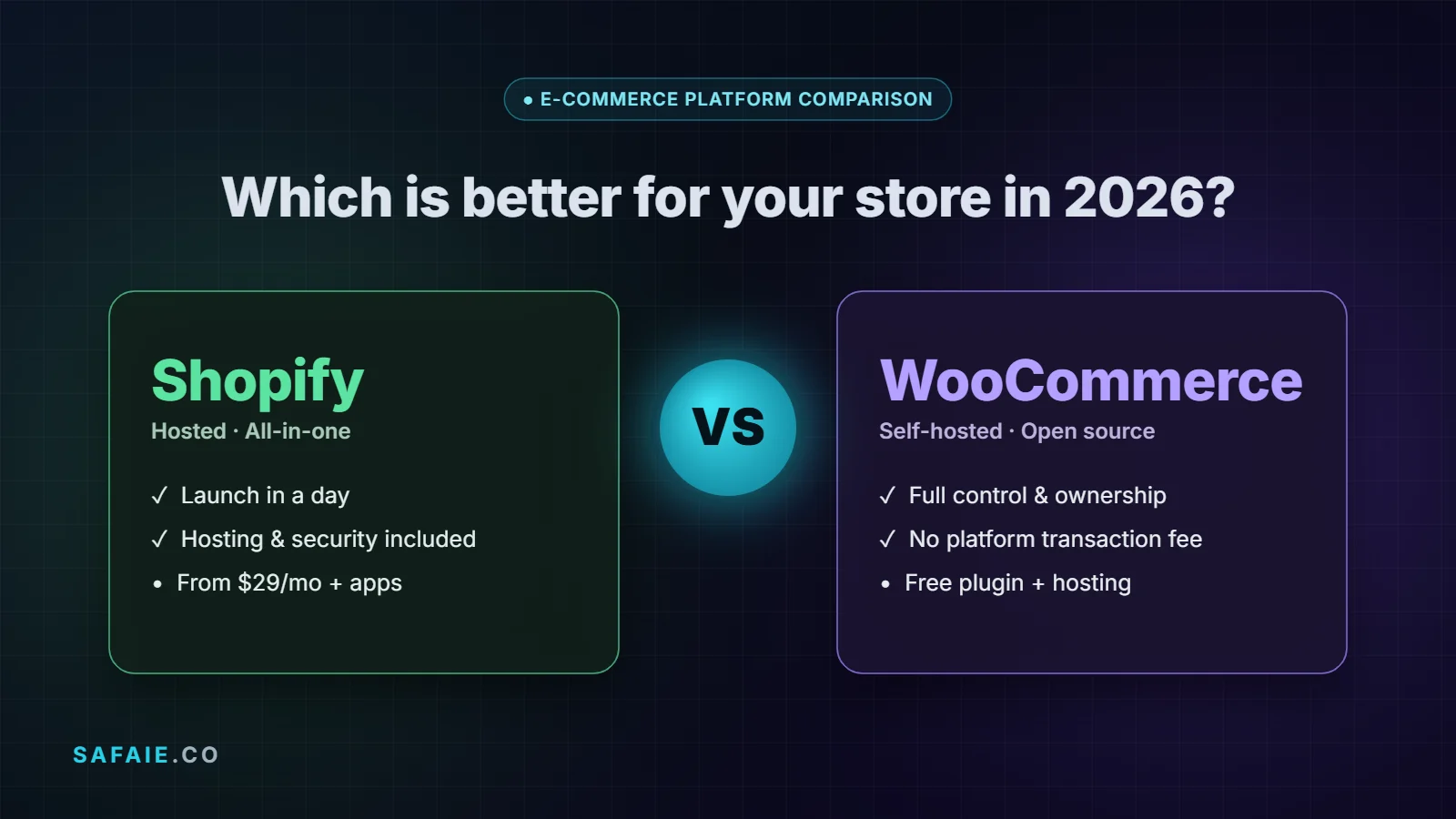
Choosing the right e-commerce platform is one of the most important decisions you will make for your online store. It affects your monthly costs, how fast you can launch, how much control you have, and how easily your store can grow.
Shopify and WooCommerce are the two most popular choices in the world, but they take very different approaches. Shopify is an all-in-one hosted platform with a monthly subscription. WooCommerce is a free, open-source plugin that turns a WordPress website into a fully featured store you own and host yourself.
In this guide we compare Shopify vs WooCommerce in 2026 across pricing, transaction fees, ease of use, design, SEO, scalability and ownership, so you can choose the right platform for your business.
Shopify vs WooCommerce at a Glance
| Shopify | WooCommerce | |
|---|---|---|
| Type | Hosted, all-in-one SaaS | Free open-source WordPress plugin |
| Starting cost | $29/month (billed yearly) | Free software + hosting from about $3–$15/month |
| Hosting and security | Included | You choose and manage it |
| Transaction fees | Extra fee if you don’t use Shopify Payments | No platform fee (only payment processor fees) |
| Customization | Good, within Shopify’s limits | Practically unlimited |
| Ease of use | Very beginner friendly | Requires some WordPress knowledge |
| Ownership and data | On Shopify’s platform | You own everything |
| Best for | Quick launch, hands-off store management | Full control, content-rich and custom stores |
Pricing: How Much Does Each Platform Really Cost?
Shopify pricing in 2026
| Plan | Monthly billing | Annual billing (per month) | Online card rate (Shopify Payments) | Third-party gateway fee |
|---|---|---|---|---|
| Basic | $39 | $29 | 2.9% + 30¢ | 2.0% |
| Grow | $105 | $79 | 2.7% + 30¢ | 1.0% |
| Advanced | $399 | $299 | 2.5% + 30¢ | 0.6% |
| Plus | from $2,300 | — | custom | custom |
US rates; prices vary by country and Shopify changes them periodically, so always confirm on Shopify’s official pricing page.
On top of the plan, most Shopify stores pay for apps (reviews, upsells, subscriptions, advanced filters and more). Many apps charge $10–$50 per month each, so app costs often add $50–$300 or more every month.
WooCommerce pricing in 2026
WooCommerce itself is free, but running a store has real costs:
| Item | Typical cost |
|---|---|
| Domain | $10 – $20 / year |
| Hosting (shared to managed WooCommerce hosting) | $36 – $600+ / year |
| Premium theme | $0 – $130 / year |
| Extensions (subscriptions, bookings, shipping, etc.) | $0 – $500+ / year |
| Payment processing (WooPayments or Stripe) | about 2.9% + 30¢ per transaction |
| Maintenance and security | $0 if you do it yourself, more with a professional |
The key difference: WooCommerce does not charge its own transaction fee and gives you full control over hosting costs. Shopify is more predictable but costs grow with apps and plan upgrades as your store scales.
Ease of Use and Setup
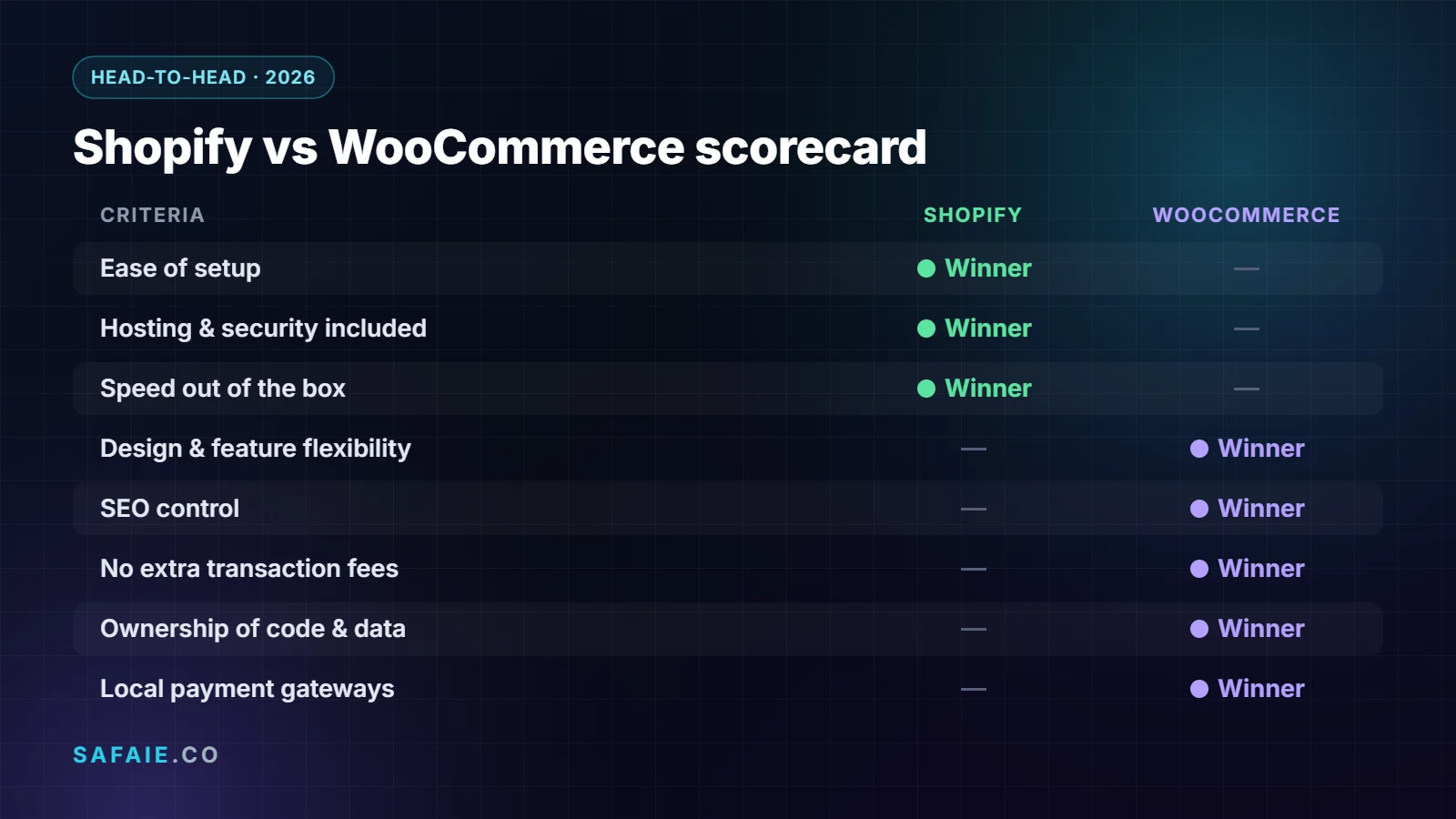
Shopify wins on simplicity. You sign up, choose a theme, add products and connect payments, and your store can be live in a day. Hosting, security, updates and backups are handled for you.
WooCommerce requires a few more steps: buying hosting, installing WordPress and WooCommerce, configuring payments, shipping and taxes, and keeping plugins up to date. In return you get much more flexibility. With a professional developer, setup is fast and you get a store built exactly for your business.
Design and Customization
Shopify offers polished themes and a visual editor, which is perfect for standard stores. However, deep changes to checkout, product logic or page structure are restricted, and some advanced customizations require the expensive Plus plan.
WooCommerce runs on WordPress, which powers over 40% of the web. You can customize every page, product type and checkout field, build unique layouts with page builders like Elementor, and integrate almost any system through thousands of plugins or custom code.
Winner for flexibility: WooCommerce.
SEO: Which Platform Ranks Better on Google?
Both platforms can rank well, but they differ in control:
- WooCommerce + WordPress gives you full control over URLs, page titles, schema markup, site structure and content. Combined with plugins like Rank Math or Yoast, and WordPress’s powerful blogging features, it is excellent for content-driven SEO.
- Shopify handles the basics well and is fast, but it forces certain URL structures (such as /products/ and /collections/), limits robots.txt and structured data customization on lower plans, and its blogging tools are more basic.
If organic search and content marketing are central to your growth strategy, WooCommerce usually offers more room to compete. Learn how our SEO services help online stores grow organic traffic.
Winner for SEO control: WooCommerce.
Performance and Speed
Shopify runs on a global content delivery network and is fast by default, though too many apps can slow it down.
WooCommerce speed depends on your hosting and how the store is built. On quality hosting, with caching, image optimization and a lightweight theme, a WooCommerce store can be just as fast. On cheap shared hosting with dozens of plugins, it can be slow.
Winner out of the box: Shopify. With professional setup: tie.
Payments and Transaction Fees
Shopify encourages you to use Shopify Payments. If you use another provider, such as a local payment gateway in your country, you pay an extra fee of 0.6%–2% on every sale depending on your plan. For a store selling $20,000 per month on the Basic plan, that is an extra $400 per month.
WooCommerce works with Stripe, PayPal, WooPayments and hundreds of local gateways with no extra platform fee. This is a major advantage for businesses in countries where Shopify Payments is not available.
Scalability
Both platforms power stores with thousands of products and millions in revenue. Shopify scales without you thinking about servers, but costs climb with higher plans and more apps. WooCommerce scales well with the right hosting and development, and you only pay for the resources you actually use.
Ownership and Control
With Shopify, your store lives on Shopify’s platform and you agree to its terms, pricing changes and restrictions. Migrating away later can be time-consuming.
With WooCommerce, you own the code, the data and the hosting. You can move to any host, change any feature and never depend on one company’s decisions.
Shopify vs WooCommerce: Which Should You Choose?
Choose Shopify if:
- You want to launch quickly with minimal technical work.
- You prefer a predictable, all-inclusive monthly plan.
- You sell standard physical products and need little customization.
- You can use Shopify Payments in your country.
Choose WooCommerce if:
- You want full control over design, features and data.
- SEO and content marketing are important to your growth.
- You need custom product types, bookings, subscriptions or complex pricing.
- You want to avoid extra transaction fees or use local payment gateways.
- You already have a WordPress website and want to add a store to it.
Frequently Asked Questions
Is WooCommerce really free?
The WooCommerce plugin is free, but you still pay for a domain, hosting, and optionally premium themes, extensions and maintenance. Payment processors also charge per-transaction fees.
Which is cheaper, Shopify or WooCommerce?
For small stores, WooCommerce is usually cheaper month to month because there is no subscription or platform transaction fee. Shopify can be more cost-effective if you value included hosting and support and don’t need many paid apps.
Is Shopify better for beginners?
Yes. Shopify is easier to set up without technical knowledge. WooCommerce has a steeper learning curve, but working with an experienced developer removes most of that complexity.
Can I move from Shopify to WooCommerce?
Yes. Products, customers and orders can be migrated with import tools or a professional migration service. Setting up redirects from old URLs is important to protect your SEO rankings.
Which platform is better for SEO?
Both can rank well, but WooCommerce on WordPress gives you more control over URLs, schema and content, which is a real advantage for content-driven and competitive niches.
Need Help Building Your Online Store?
At Safaie we design and develop fast, secure and SEO-ready online stores built around your products and customers. Whether you choose WooCommerce or need a custom solution, we can help you plan, build and grow your store. Explore our e-commerce development services or read our guide on how much a website costs in 2026.
1 comment on “Shopify vs WooCommerce in 2026: Which Is Better for Your Online Store?”